ThirdEYEby Varuna
The enterprise AI security operations platform
A fully AI-native platform for the whole SOC: agentic AI, MCP tools, a multi-LLM brain with fallback, SIEM, detection, threat intelligence, hunting, SOAR and UEBA as one system. It investigates with built-in logic first and AI models when needed, then carries each outcome to cases, playbooks and tickets.
Built for SOC analysts, detection engineers and security leads who run Elastic, Splunk or Wazuh and want faster, explainable triage.
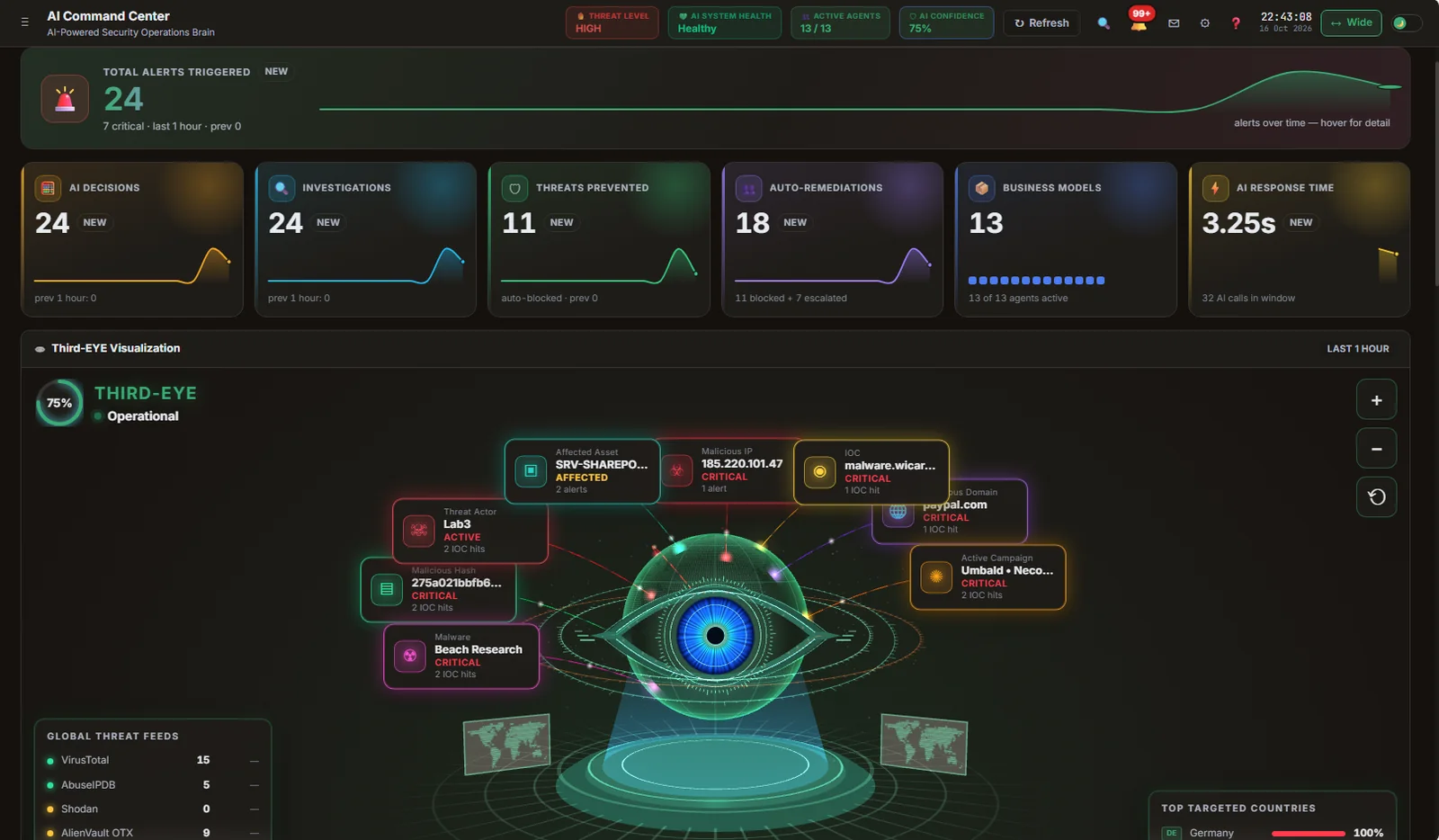
The AI Command Centre, from a test environment with simulated alerts. See the product tour.
Two ways to run ThirdEYE. Use one, or both.
Start from your devices, or start from the alerts you already have. The same investigation, AI and response engine sits behind both.
Mode 1
As your SIEM and SOAR
Onboard your devices straight into ThirdEYE. It collects the events, detects with its rule catalog, correlates, investigates with AI and runs playbooks, so one platform does the job of a SIEM and a SOAR.
- No per-EPS charge, built for up to 5,000 events per second
- Any device or tool that can send JSON over HTTP, plus Windows, Sysmon and Linux collectors
- Built on a free, open-source stack, with local AI models if you want zero AI cost
5,000 events per second is the design target. Our scale test measured 1,300+ per second on a single process; confirm on your hardware.
See Mode 1 in detailMode 2
As an AI agentic SOC for all your alerts
Keep the security tools you have. Send their alerts to ThirdEYE from any security device, and AI agents analyse every one with LLMs and rules, decide, and respond.
- No cap on alert count. Rules and remembered analyses clear known patterns, LLMs handle the rest
- Alerts from any security device or tool that can send them
- Analysis never stops: the LLM fallback chain ends in built-in rules
LLM limits come from the providers you connect. Local models have none beyond your hardware.
See Mode 2 in detailTake the 2-minute tour
From the control room to the evidence behind one alert, and how the AI falls back when a model is not available.
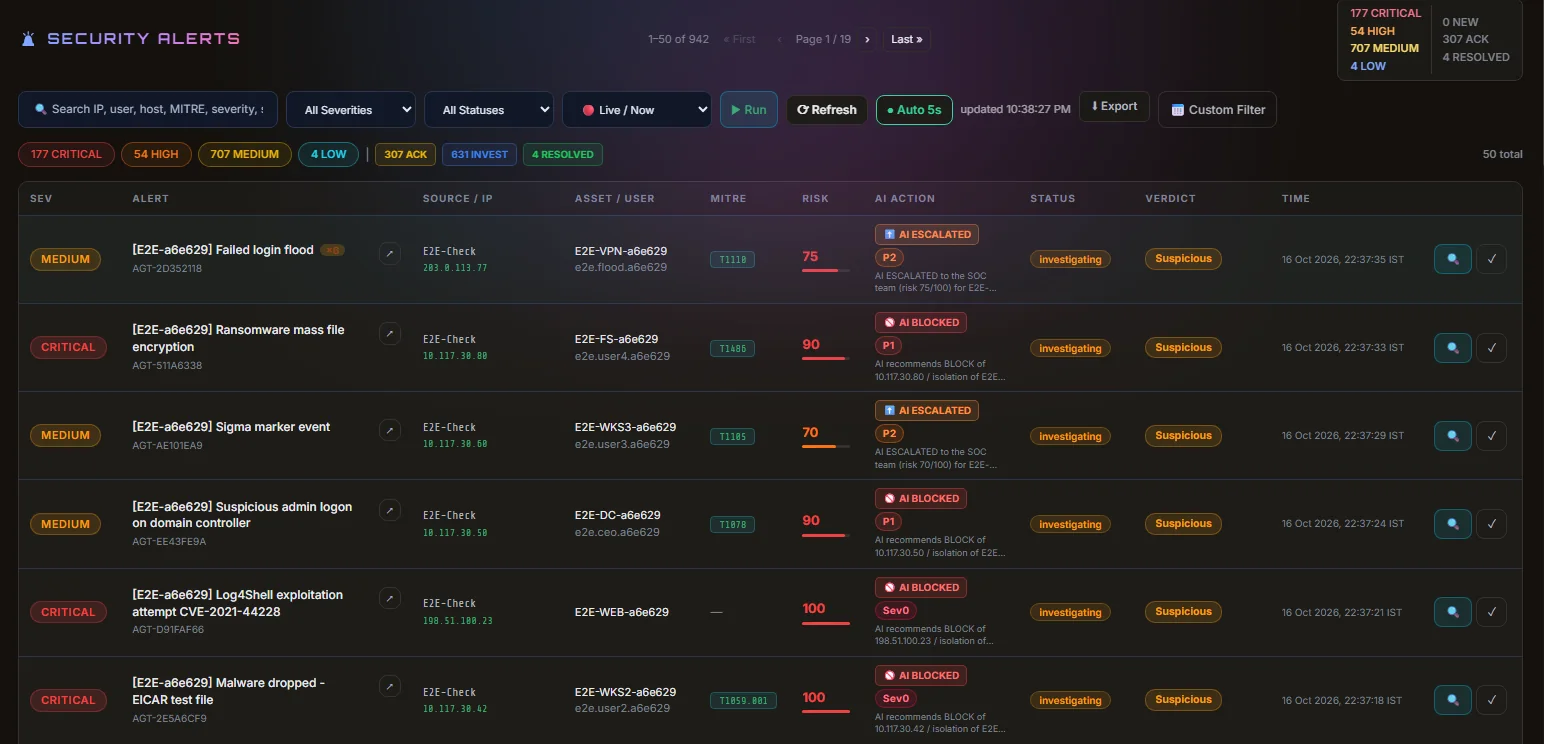
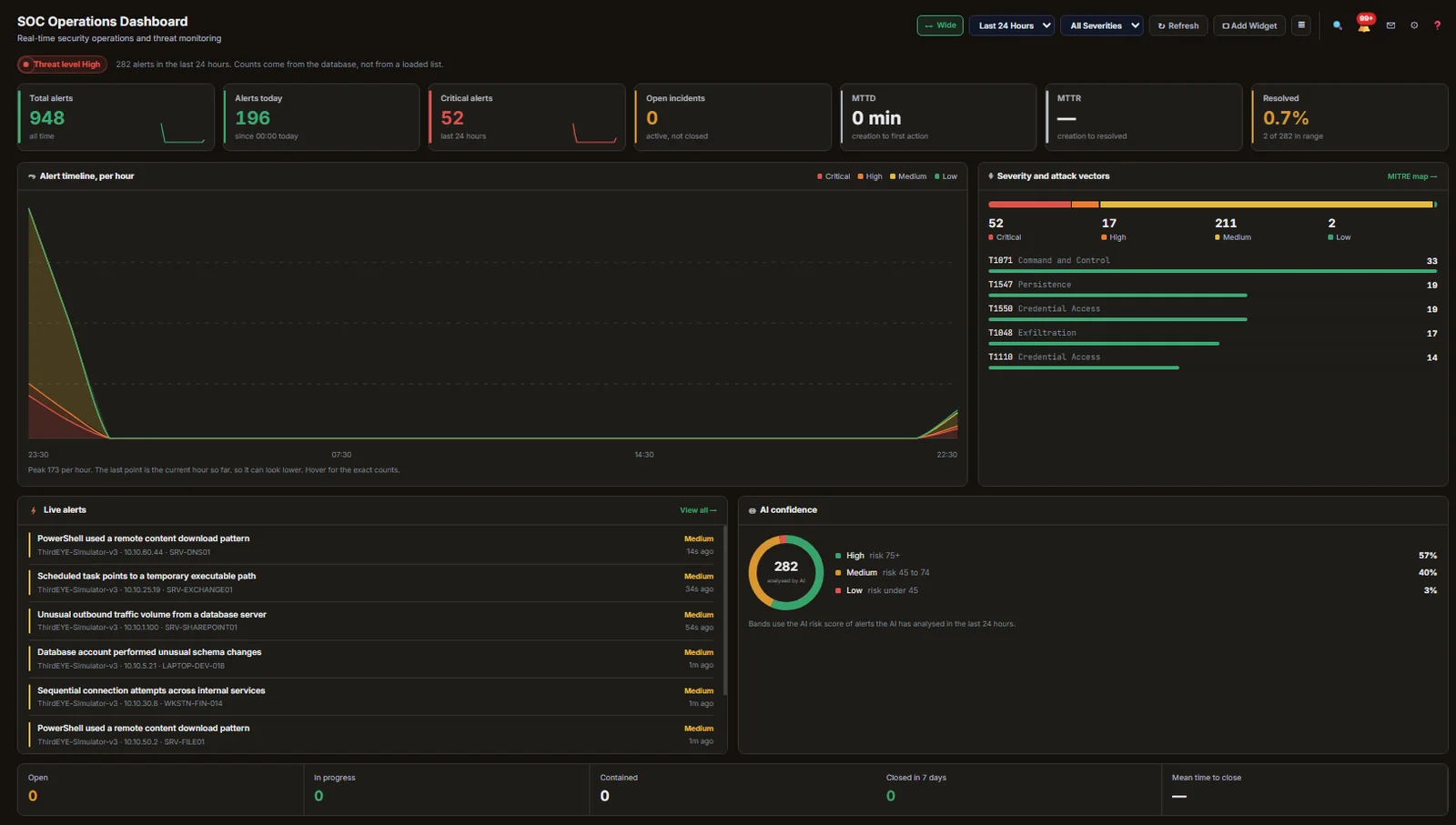
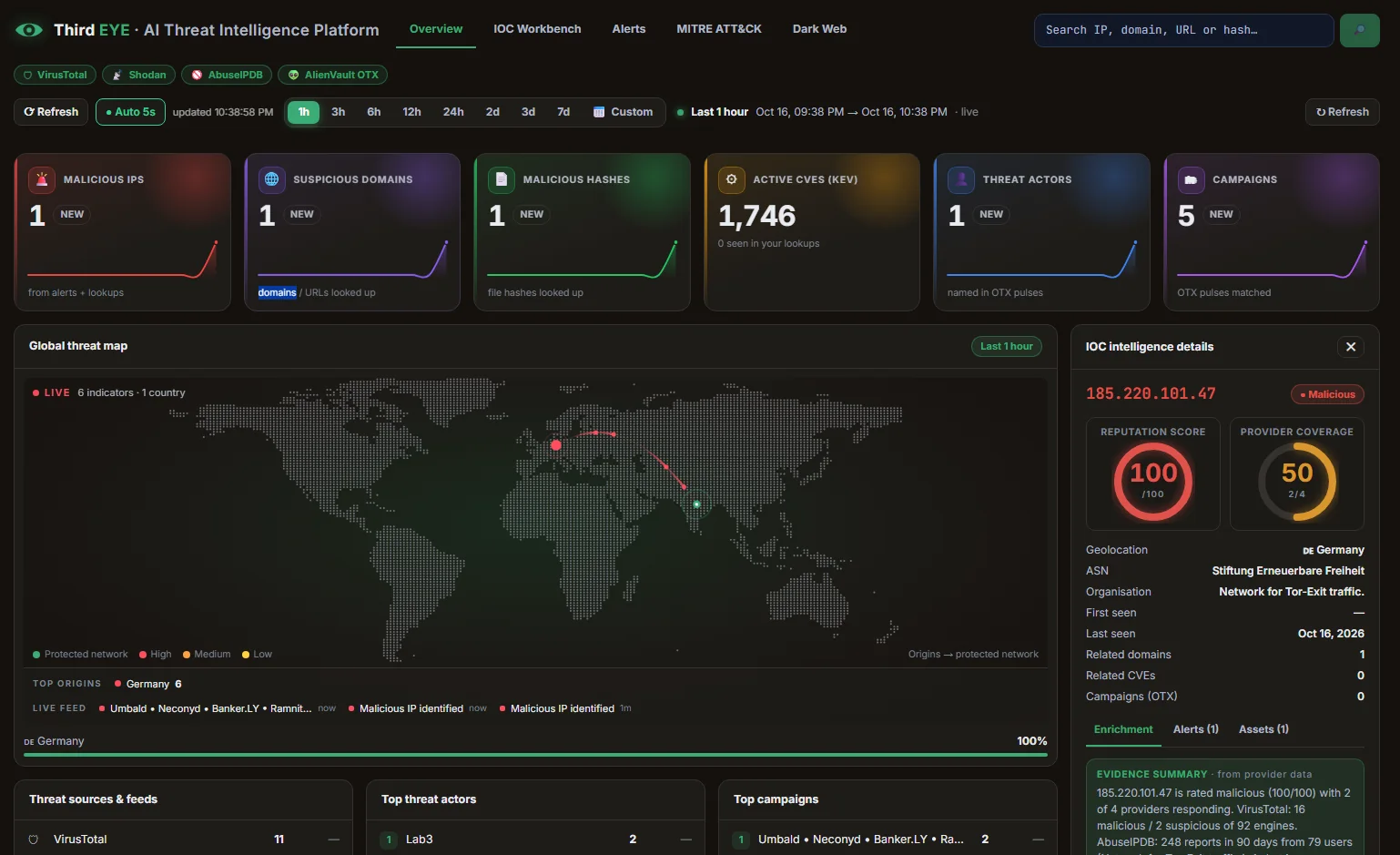
The console, on real screens
Every alert shows what the AI did and why. These are from a test environment with simulated alerts.
Built around the problems SOC teams actually have
Alert volume outruns the team
Known patterns are resolved by built-in rules and remembered analyses before any model is called. Analysts see the alerts that need judgement.
AI costs and quotas are unpredictable
A token budget, per-tenant policy and a fallback chain keep analysis running on free tiers or local models, and every call is logged.
Tools do not talk to each other
One path from alert to case: detection, correlation, enrichment, decision, playbook and ticket, with the reasoning kept at each step.
Also built to run as an agentic SOC
The same platform works as an agent-driven SOC: agents do the investigation work, MCP tools let them and your own AI clients reach the data, and fallback keeps it running when a model or a database is not available.
13 agents
Triage, investigation, SOAR, UEBA, dark web, compliance, threat hunting and auto-remediation agents, plus specialists for phishing, ransomware and lateral movement.
MCP tools
23 tools for external AI clients and a 38-tool gateway in four risk tiers, with every action tool approval-gated.
LLM fallback
Five providers and a six-step chain that ends in built-in rules, so analysis degrades instead of stopping.
Database failover and recovery
If the primary database is unreachable the platform keeps working on a local fallback and syncs the data back when the primary returns.
Machine learning and behaviour analytics
Behaviour baselines from your own history, an Isolation Forest anomaly model and semantic memory. See what is live and what is optional.
Every capability, with its status
Open any capability to see what it does, how far it goes and what it needs.
What it replaces, and what it does not
Ten functions teams usually buy separately, and three it leaves to specialist tools.
From alert to decision in four stages
Every alert follows the same path, and each stage records what it concluded and why, so an analyst can check the work instead of trusting a score.
- See
Ingest
Events arrive from Elastic, Splunk, Wazuh, agents or a webhook, and are normalised into one alert model.
- Understand
Detect and correlate
Rules and correlation group related activity, map it to ATT&CK and reuse earlier conclusions for near-identical alerts.
- Decide
Investigate
Security AI answers what it can from rules and confirmed history. Otherwise enrichment and, if allowed, a model produce a verdict and risk score.
- Respond
Act with control
Thresholds decide what waits for a person. Playbooks, cases and tickets follow, with approvals, rollback and an audit trail.
Try the decision path
Most of the cost and risk in AI-assisted triage is deciding when to call a model. Pick a situation and see which steps ThirdEYE takes, and which it skips.
- Reuse an earlier conclusion
Compare with correlated alerts from the last 24 hours.
- Security AI: rules and confirmed memory
Match the rule catalog and analyses a person has confirmed.
- Enrich and map
Extract indicators, query threat intelligence, map to ATT&CK.
- Model analysis
Ask a configured provider for a verdict and risk score.
- Rule-based fallback
Used only if no model answered.
- Decision thresholds
Block, escalate, investigate or triage, with a logged justification.
Illustrative walkthrough of the documented decision order. Not live data. Which steps run in a real deployment depends on severity, configuration and the models you connect.
The same SOC, with and without it
A qualitative comparison, not a promise of savings. Your results depend on your alerts, tools and models.
Without ThirdEYE
- Alerts arrive in many tools and queues
- Analysts re-investigate patterns they already judged
- AI calls are ad hoc, unlogged and unbudgeted
- Response steps live in documents and chat
- Evidence is spread across consoles
With ThirdEYE
- One alert model and one case view
- Known patterns reused before any model call
- Every AI call logged, budgeted and explained
- Playbooks with approvals, rollback and audit
- Evidence and reasoning kept at each step
What is actually built
Counted from the product, not estimated. Each number says what it does and does not mean.
- 13agents
- 8 control agents (triage, investigation, SOAR, UEBA, dark web, compliance, threat hunter, auto-remediation) and 5 specialists. Depth varies by agent. See details
- 1,412ATT&CK workflows
- An Investigate and a Respond runbook for each of 706 MITRE techniques. All manual: an analyst approves, nothing runs by itself. See details
- 58built-in playbooks
- Plus 108 one-click prompts in 9 categories that make the AI generator draft new ones for your review. See details
- 1,396detection rules
- 103 written for the platform and 1,293 imported from the open Sigma project, with a visual builder for your own. See details
- 5LLM providers
- Groq, Gemini, Mistral, OpenAI and local Ollama. The default chain holds 10 hosted free-tier models before a paid or local one. See details
- 6step fallback chain
- Groq, Gemini, Mistral, OpenAI, Ollama, then built-in rules. Analysis degrades instead of stopping, and fallback results never auto-close an alert. See details
- 38MCP gateway tools
- 18 read-only enrichment, 5 investigation, 1 AI summary and 14 action tools that always need approval. Optional: ThirdEYE runs without it. See details
- 23MCP server tools
- Alerts, investigation, incidents, enrichment, playbooks, hunts and agent control, available to any MCP-capable AI client you connect. See details
- 2database modes
- A PostgreSQL cluster, or a local fallback that syncs back automatically when the primary returns. Recovery sync is tested; two-server failover is a documented design. See details
What the platform covers
Each capability carries its real status. Where something needs configuration or is only partly built, the label says so.
Detection engineering
1,396 catalog rules (103 built in, 1,293 imported Sigma), a visual rule builder and correlation across alerts.
AvailableAI-assisted investigation
Automatic investigation with MITRE ATT&CK mapping, threat-intel enrichment, similar-incident memory and a logged justification for each decision.
AvailableSecurity automation
58 built-in playbooks, a no-code builder, an AI drafter that always waits for human review, approvals and rollback.
ConfigurableThreat hunting
An ad-hoc query workbench over connected sources, with AI-assisted query suggestions.
ConfigurableCases and ticketing
Cases with SLA tracking and evidence chain, synced to TheHive, ServiceNow, Jira, GLPI or Zammad.
AvailableGovernance and audit
Role-based access, tenant-scoped policy, token budgets and a hash-chained audit trail for AI and response activity.
Architecture at a glance
ThirdEYE is deployed in your environment. Connectors bring data in; identity, tenancy and audit apply across every stage.
AI you can govern, and afford
Most of the cost and risk in AI-assisted security sits in how models are called. ThirdEYE treats that as a design problem.
- Rules first. Known patterns and previously confirmed analyses are resolved without a model call.
- Your choice of model. Cloud providers, local Ollama models, or rules only, set per tenant.
- Budgets and fallback. A daily token budget degrades analysis to a lighter mode; fallback results are marked and never auto-close an alert.
- Everything logged. Provider, tokens, outcome and justification for each call, with a hash-chained audit trail.
What it will not do
- Pretend to be your endpoint sensor: it reads from your SIEM and EDR and does not replace the sensors.
- Run live response actions unless an administrator turns live mode on and configures a provider.
- Close high or critical alerts automatically on a fallback result.
- Present synthetic demo data as live telemetry.
Works with the tools you have
Eleven integration types, each labelled by how far it goes today.
REST API
Documented, token-authenticated API.
Webhooks
Inbound alerts and outbound pushes.
SIEM connectors
Elastic, Splunk, Wazuh, QRadar, Sentinel.
Collectors
Windows, Sysmon and Linux agents.
Threat intelligence
VirusTotal, AbuseIPDB, Shodan, OTX.
Response providers
Defender, Entra, Okta, CrowdStrike, Wazuh, firewall webhook.
Ticketing
TheHive, ServiceNow, Jira, GLPI, Zammad.
Notifications
Email (SMTP) and Microsoft Teams.
AI models
Five LLM providers and local Ollama.
MCP
Server and gateway for AI clients.
Observability
Prometheus and Grafana.
Integrations, with honest maturity labels
Elastic, Splunk, Wazuh, QRadar and Sentinel on the SIEM side; TheHive, ServiceNow, Jira, GLPI and Zammad for cases; any tool that can post JSON over a webhook. Each is labelled by how far it goes today.
Deploy it where you work
Docker, Linux or Windows, with local models available for environments that cannot send data out. A PostgreSQL replication design is documented for high availability.
More from Varuna
ThirdEYE is the first product. Argus and OT Command Centre are in development. Tell us what you need and we will keep you informed.
Why the numbers above matter
They are counted from the product and each one says what it does and does not mean. The same honesty applies to every capability on this site: what ThirdEYE covers, and what it leaves to specialist tools.
Frequently asked questions
Who is Varuna and what is ThirdEYE?
Varuna is the company. ThirdEYE is its first product, a security operations platform. It ingests alerts and events, applies detection rules and correlation, investigates alerts with a combination of built-in logic and optional AI models, and routes the outcome to cases, playbooks and ticketing. It is delivered as software you deploy, not as a hosted service.
Does it replace our SIEM, EDR or SOAR?
No. ThirdEYE is designed to sit beside the tools you already run. It can read from Elastic, Splunk and Wazuh, accept events from any source over a webhook, and hand cases to your ticketing system. Where it overlaps with a SIEM or SOAR, you decide how much of that function to use.
Do we need to send data to an external AI provider?
No. Analysis works with built-in rules only, with local open-source models through Ollama, or with cloud providers such as Groq, Gemini, Mistral and OpenAI. Policy can be set per tenant. When cloud providers are used, prompts are masked before they leave, and credentials are masked by default.
What happens if the AI provider is down or the quota runs out?
Analysis falls back along a configured chain and ends in rule-based logic, so alerts are still triaged. Results produced by the fallback are marked as such and never close an alert automatically.
Do response actions really change our systems?
Not by default. Response actions run in simulate mode until an administrator enables live mode and configures a provider (for example Wazuh, CrowdStrike, Defender, Entra ID, Okta or a firewall webhook). Simulated actions are labelled as simulated everywhere they appear.
Which integrations are production-ready?
The integrations page lists each connector with an honest maturity label: available, requires configuration, partial or planned. Several connectors are implemented but have not yet been validated against live third-party systems, and we say so.
How is it priced?
Commercial terms are discussed with the team and depend on deployment and integration requirements. There is no public price list. Costs of any optional external AI provider or your own infrastructure are separate from software licensing.
Is it certified (SOC 2, ISO 27001)?
No certifications or independent audits are claimed. The security page documents the controls that exist in the product and the responsibilities that stay with the operator.
See it on your own alerts.
Book a walkthrough with the team. We will show the platform end to end, tell you what is production-ready and what is not, and discuss how it would sit next to your existing SIEM.